Journal
Video or in person: how to choose
What changes on a screen and what doesn't, why the law cares where you are sitting, and how to make a video session private.
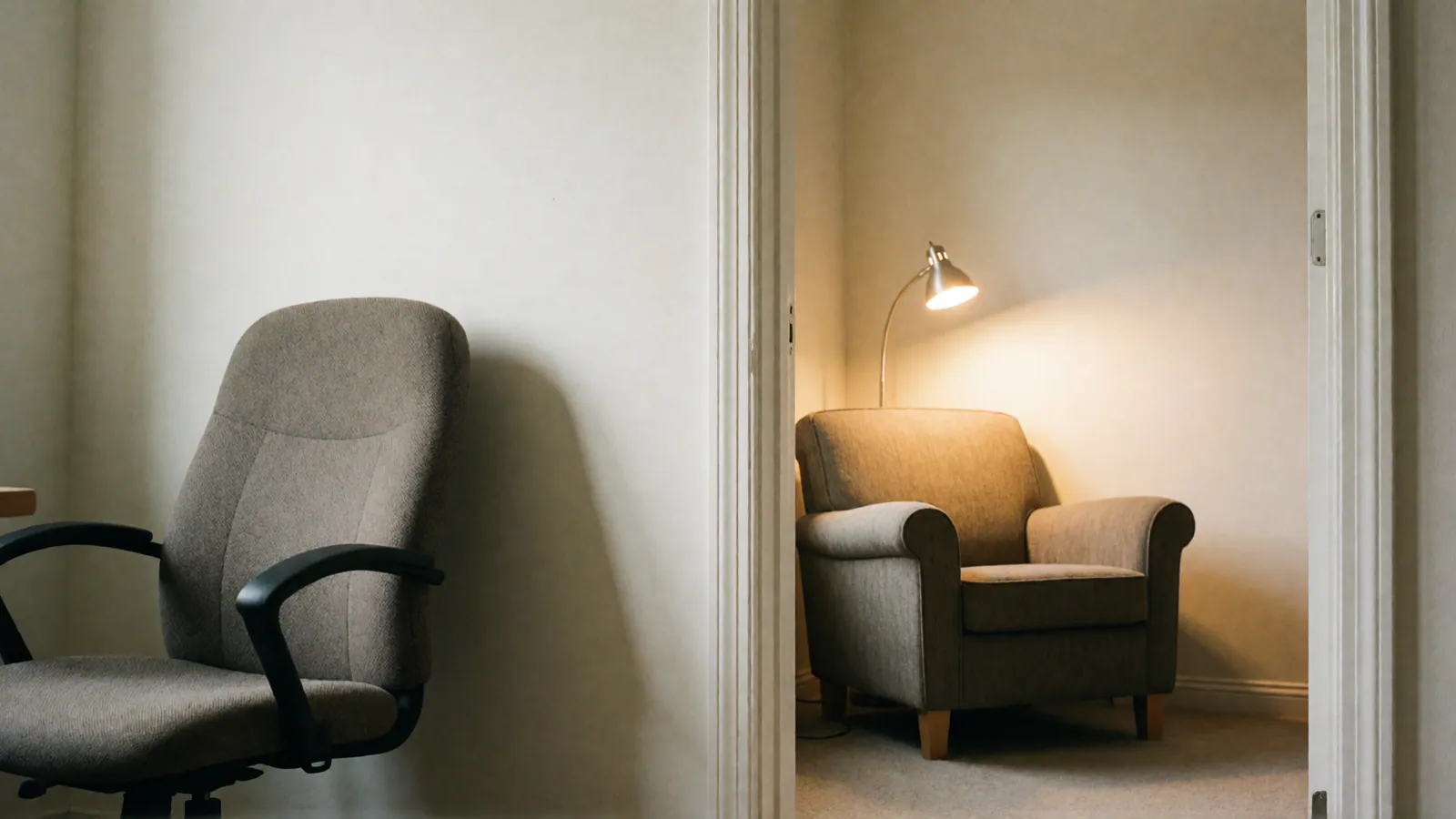
AI-generated illustration. Not a real office.
Neither is the better way to do therapy. They are two ways of sitting in the same conversation, and the useful question is which one you will actually keep up. Here is what changes between them, what does not, and what to arrange if you choose a screen.
How this practice does it
Office days and video days. Each clinician's day is either an office day, when every session is in person here, or a video day, when every session is by video. Choose in person or video and the calendar shows you the times that fit.
That means the choice is made when you book, not in the session. This table shows each clinician's days:
| Day | Rosa | Joaquín | Maricel | Nusrat | Mei |
|---|---|---|---|---|---|
| Monday | Office, 10 am to 7 pm | Video, 1 pm to 9 pm | — | Office, 9 am to 5 pm | Video, 9 am to 5 pm |
| Tuesday | Video, 12 pm to 9 pm | Office, 1 pm to 9 pm | Office, 12 pm to 9 pm | — | Video, 9 am to 5 pm |
| Wednesday | — | Office, 1 pm to 9 pm | Video, 12 pm to 9 pm | Office, 9 am to 5 pm | Office, 1 pm to 9 pm |
| Thursday | Office, 10 am to 7 pm | — | Office, 12 pm to 9 pm | Video, 1 pm to 9 pm | Video, 9 am to 5 pm |
| Friday | — | — | Office, 9 am to 5 pm | Video, 9 am to 5 pm | — |
| Saturday | Video, 9 am to 1 pm | Office, 9 am to 2 pm | — | — | — |
You can move between the two with your clinician.
What changes on a screen
On video, you see a face and a room, and you lose most of the rest: posture, the way a person sits when a hard subject comes up, the quiet before an answer. Clinicians and clients both adapt, and a good connection and a steady camera help, but you should expect it to feel a little different.
You also save the trip. No commute can mean a session at the end of a working day without the hour either side being lost. Some people find the first minutes easier to begin from their own chair. Some find it harder to leave the session behind when it ends in the same room where they will cook dinner.
If a call drops or a child walks in, say so and carry on. It happens to everybody.
What does not change
The same fifty minutes and the same fee, from wherever you have a door you can close.
A session is fifty minutes either way, with the same clinician and the same fee for each kind of session.
Why the law cares where you are sitting
In New York State. Video sessions are for clients who are physically in New York State at the time of each session, because that is the state a New York license covers. If you're traveling outside New York, we may need to pause video sessions or meet in person when you're back.
When you book a video session, you are asked to confirm: “I will be physically in New York State during video sessions.”
It is a practical matter, not a test of trust. If you will be away, tell your clinician early, and the two of you can plan around it.
Making a video session private
Your clinician sends you a private video link before the session; you need a quiet room with a door, a device with a camera, and headphones if anybody else is home. Nothing to install from this website, and nothing recorded.
A few more things help. Tell the people you live with that you will be unavailable and when. Put something between your voice and the rest of the home, such as a closed door, a fan or music playing outside it. Put your phone on silent. Use the same spot every week, so that the room starts to mean something.
A parked car is not a room with a door, and a kitchen with a family in it is not either. If there is no place at home where you can talk freely, that is a good reason to choose the office, and a good thing to mention on the free call.
When the office suits better
The office suits you better if home is not private, if you find it hard to start on a screen, or if the work is the kind that benefits from being in a room with another person. Couples and families often find it easier to talk in person, because it is harder to leave a room than to close a laptop.
The office is a second-floor suite in a prewar building, reached by an elevator or a flight of stairs, with a quiet waiting area, three therapy rooms with sound-softening machines outside their doors, and a restroom on the floor. If the office is hard for you to reach for any reason, every clinician also keeps video days.
How to choose
Choose the one you will keep up. If you are not sure, begin with the one that is easier to get to, and ask about the other later. Your clinician would rather hear that a format is not working than have you stop coming.
Video sessions has the calendar for video days, and the office shows what the rooms are like.
General information, not advice for you. Nothing on this website can tell you what is going on for you. A diagnosis, where one is needed, comes from a clinician who has met you — never from a page, a quiz or a booking form.
Book a free call
Book a free fifteen-minute call, or go straight to a first session if you know what you want. Nothing is paid online, and nothing on the form asks why you're coming.